C.STATION
Automate cell line development–integrating single-cell isolation, imaging and clone selection into one efficient, compliant workflow.

The UP.SIGHT combines gentle, low-shear single-cell dispensing with integrated fluorescence and 3D-well imaging to support high cell viability and clonal outgrowth. By replacing a separate dispenser, plate imager and fluorescence reader, it brings dispensing, day-X imaging, VCD and titer data into one clone-centric record for streamlined, data-driven selection of your best clones.
Start your CLD campaign with the end in mind by isolating top clones with IND-ready proof of monoclonality, ready to enter manufacturing in weeks.
Achieve >97% single cell sorting efficiency, finishing a 96-well plate in 2 minutes, 384 well plates in 8 minutes, using only a few microliters of your sample per plate.
Generate independent image-based proof of monoclonality from both nozzle and well imaging to support your IND filings.
Achieve clonal recovery rates of up to 80%, including fragile hiPSC lines, with gentle piezo dispensing and optimized workflows.
No complex cleaning process, single use consumables eliminate cross contamination risks. 5 minute set up and shut down time gives scientists time to focus on the science, not the operation.
Automatically quantify viable cell density (VCD) with AI-powered analysis validated across a 3-log linear range.
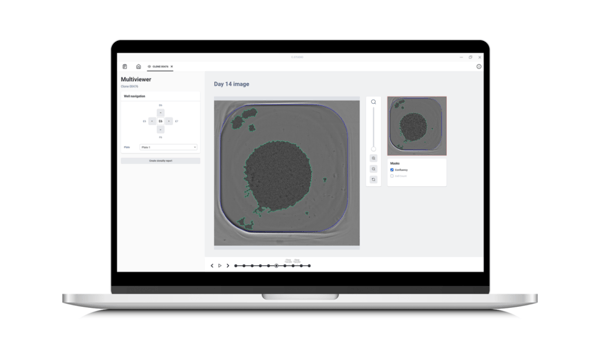
Monitor clonal outgrowth, confluency, and cell health over time with integrated imaging and clone-centric software.
Two independent imaging systems provide IND-ready proof of monoclonality from Day 0—not just probability. The first image is captured at the dispensing nozzle, the second at the well bottom, providing two independent confirmations of clonal origin.
CYTENA's dispensing technology and monoclonality reports are the gold standard for IND filings. By adopting this workflow today, you can reduce tomorrow's regulatory burden. The system is compatible with 21 CFR Part 11, GMP and widely adopted in mAb manufacturing and hiPSC-based allogeneic cell therapy facilities.
C.STUDIO is the companion software for the UP.SIGHT, tracking clones with unique clone IDs and centralizing all your clone intelligence in one place. Every dispense, Day-X image, confluency measurement, viable cell density (VCD), and titer result is captured automatically and linked to each individual clone.
With every data point connected in a single platform, C.STUDIO simplifies data-driven clone selection without patching together fragmented datasets. Nothing to merge, no version chaos, and no data silos.
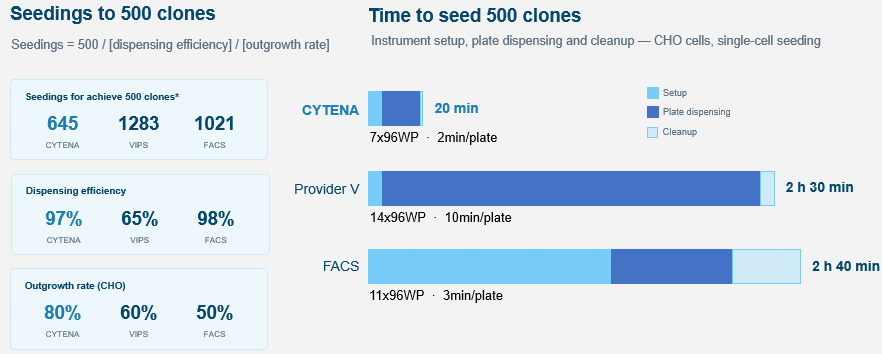
With a dispensing efficiency of 97% and a clone outgrowth rate of >80%, it takes only 645 wells and 20 minutes of dispensing to yield 500 high-quality clones. It takes alternative dispenser at least 40% more wells and 400% longer compared to the UP.SIGHT.
The outcome is faster cell line development with fewer consumables, less labor, and more confidence in every clone.

A clone's value is determined by its productivity, the titer per viable cell. Traditional cell counters cannot accurately measure freshly cloned wells, delaying clone selection by 2–4 weeks. Earlier clone selection reduces incubator space, media consumption, and the time spent growing clones that were never going to make it. The UP.SIGHT closes that blind window by combining F.QUANT titer assays with AI-powered VCD, enabling productivity measurements from as little as 30 µL of low-cell-density samples.
The UP.SIGHT uses a bottom optic module for brightfield, green and red fluorescence imaging. It enables colony growth tracking, VCD and titer.
A specialized AI model enables linear VCD assessment across an exceptional 3-log of cell density with a %CV <7%. In combination to F.QUANT titer assay, it enables early clone productivity assessment.
Image-based dispensing enables gated cell selection based on cell size, roundness, and fluorescence while providing a first proof of clonality. If no cell is detected in the dispensing area—or if multiple cells are present—the droplet is automatically discarded. Only single cells that meet your sorting criteria are dispensed at speeds of ~40 wells per minute.
Include or exclude labelled cells by green fluorescence (488 nm laser; 561 nm on request), in addition to cell size and roundness, for more precise sorting decisions. Inquire for alternative fluorescence options.
Perform 3D stack imaging of the well as the dispensed single cell settles toward the well bottom, providing in-line clonality evidence before the cell has any opportunity to divide.
Detect single cells in both 96- and 384-well plates. Combined with dispensing, nozzle imaging, and cell settling, Day-X well-bottom imaging provides multiple layers of monoclonality evidence while enabling long-term tracking of clonal outgrowth, confluency, and viable cell density.
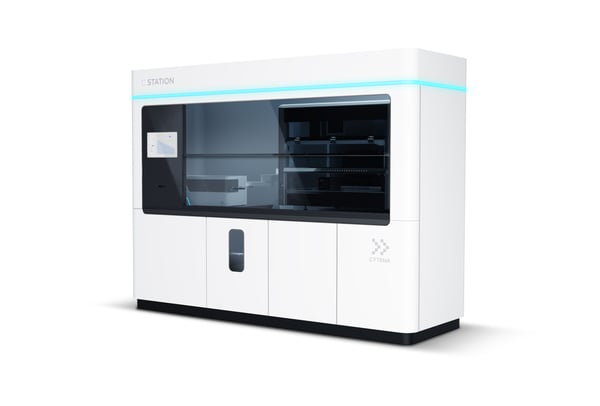
A programmable lid and accessible plate carrier enable seamless integration into automated workflows with virtually any scheduler. Whether used as a standalone instrument, paired with a robotic arm, or incorporated into a fully automated CLD workcell, such as the C.STATION, the system is designed to scale with your automation needs.
Image-based dispensing enables gated cell selection based on cell size, roundness, and fluorescence while providing a first proof of clonality. If no cell is detected in the dispensing area—or if multiple cells are present—the droplet is automatically discarded. Only single cells that meet your sorting criteria are dispensed at speeds of ~40 wells per minute.
Include or exclude labelled cells by green fluorescence (488 nm laser; 561 nm on request), in addition to cell size and roundness, for more precise sorting decisions. Inquire for alternative fluorescence options.
Perform 3D stack imaging of the well as the dispensed single cell settles toward the well bottom, providing in-line clonality evidence before the cell has any opportunity to divide.
Detect single cells in both 96- and 384-well plates. Combined with dispensing, nozzle imaging, and cell settling, Day-X well-bottom imaging provides multiple layers of monoclonality evidence while enabling long-term tracking of clonal outgrowth, confluency, and viable cell density.
A programmable lid and accessible plate carrier enable seamless integration into automated workflows with virtually any scheduler. Whether used as a standalone instrument, paired with a robotic arm, or incorporated into a fully automated CLD workcell, such as the C.STATION, the system is designed to scale with your automation needs.
“Axxam has revolutionized the limiting dilution process with the UP.SIGHT instrument over the past year. We experienced the power of this remarkable tool with its intuitive interface and double assurance of clonality, enabling us to accelerate the production of stable monoclonal cell lines expressing a diverse range of targets for our high-throughput screening campaigns.”
“UP.SIGHT is a very gentle and reliable cell dispensing system that allows for automation of assuredly monoclonal cell line generation with our very large and fragile protoplasts. The UP.SIGHT is easy to handle and easy to integrate into the existing lab due to its small footprint.”
“We can isolate one cell, one clone that has the exact desired genome, and we need to prove from a regulatory purpose that there is just one cell in any well. For this purpose, we selected the UP.SIGHT, where we make use of the double clonality assurance to be confident in the results
"Single cell efficacy: 70-93%; Colony efficacy: 58-91% (after optimization). The plating effort (to get single cells) can be lowered compared to limited dilution and FACS single cell deposition by the factor 4-5."
"Pro: High precision of single-cell printing and strong confidence of monoclonality. Automation API and excellent technical support. Con: Manual sample loading, medium throughput, occasional cartridge-to-cartridge variations."
"When using the single-cell printer, the number of monoclonal cell lines increased 6-fold compared to the limiting dilution process, therefore increasing the number of pools that could be cloned. By implementing both of these technologies, the cell line development process can be decreased from 9 months to 6 months."
"ExcellGene SA relies on the Cytena Single Cell Dispenser, which offers both single cell dispensing and imaging capabilities. This technology provides documented evidence of clonality for all dispensed cells, ensuring the integrity and reliability of the resulting cell lines. The user-friendly nature of Cytena devices makes them invaluable tools for streamlining and optimizing laboratory workflows."
UP.SIGHT is used across modern cell line development workflows to improve monoclonality confidence, increase clone recovery, and streamline clone selection. The following publications and case studies demonstrate how researchers apply image-based single-cell isolation in real development programs.
High-quality hiPSC line development at LUMC using gentle microfluidic dispensing and nozzle-based imaging for improved cell viability and colony outgrowth.
Automated cell counting and viable cell density (VCD) measurements directly in microplates using AI image analysis, heavily reducing sample consumption and tip waste.
Rapid clonal derivation and double assurance of monoclonality on a single platform through integrated nozzle imaging and 3D well imaging.
Accelerated VCD measurements and reduced plastic waste in cell line development campaigns powered by integrated AI well imaging and automated clone tracking.
Automate cell line development–integrating single-cell isolation, imaging and clone selection into one efficient, compliant workflow.

Centralized software of continuous clone tracking and image analysis.
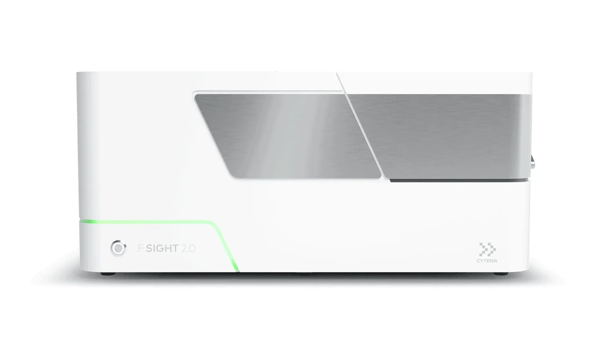
Dual-channel fluoroscent and brightfield sorting for precise isolation of labeled cells.
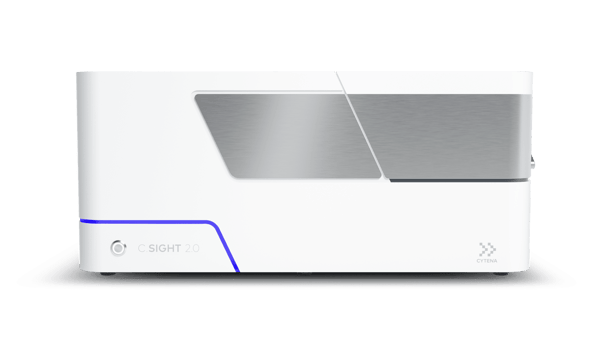
Fast, label-free single-cell isolation engineered for high viability and outgrowth.
C.SIGHT is the entry image-based dispenser. F.SIGHT adds a fluorescence channel and AOC center-of-well precision. UP.SIGHT is the all-in-one system, with a plate bottom imager that adds a second, in-well assurance of clonality (>99.99%), tracks Day-x clone growth (cell count and confluency), enables VCD and titer assay readout and advanced clone analytics for early selection with C.STUDIO.
Every CYTENA dispenser images the single cell at the nozzle, giving a first, visual assurance of clonal origin at day 0. This provides evidence, not a probability as signal-based sorting such as FACS. UP.SIGHT and C.STATION add a second, in-well assurance for the highest level of documented monoclonality.
AOC places the cell-containing droplet precisely at the centre of a conical well, in as little as 1 µl of buffer. That precision enables sub-microlitre reactions and library-prep miniaturisation for single-cell omics. AOC is available on F.SIGHT and UP.SIGHT (and on C.STATION via UP.SIGHT).
Yes. Verified single-cell isolation gives clean, doublet-free input, while non-contact picolitre dispensing and AOC allow miniaturised, reagent-saving library preparation for NGS and other omics. F.SIGHT and UP.SIGHT are best suited, adding fluorescence selection and centre-of-well precision dispensing.
UP.SIGHT captures two independent proofs: a nozzle image of the single cell, then Full Well Imaging of the single cell in the well. Together they deliver a >99.99% probability of monoclonality.
No. You can simply let the cell sediment at the well bottom. Alternatively, when dispensing in 384-well plates with UP.SIGHT's 3D Full Well Imaging, the full liquid volume is imaged right after dispensing while the cell sinks in, so a single cell is verified without the extra centrifugation step traditional imagers require or any waiting time — saving time and handling.
Weeks earlier than usual. UP.SIGHT's AI-based VCD reads freshly cloned, low-density wells that standard counters can't — across a 3-log linear range at under ~7% CV, up to 384 wells per run — so you rank and cut clones from the earliest outgrowth and combine that data with titer measured with F.QUANT as early as Day-14
Yes. Well-bottom imaging on the UP.SIGHT follows each colony from day 0 to day X, measuring confluency or cell count for both adherent and suspension cells, so growth history informs clone selection — all recorded in C.STUDIO.
Yes. UP.SIGHT runs standalone today and drops into a C.STATION or GO.SIMPLE workcell when your throughput grows, using the same dispensing core — so there is no wasted CAPEX and no re-validation of the underlying technology on the path to automation.